Essential Peanuts Introduction by Patrick McDonnell
Skip to comments
Exclusive to The Daily Cartoonist is Patrick McDonnell‘s Introduction to The Essential Peanuts.
“A Bringing of Happiness” – Introduction by Patrick McDonnell

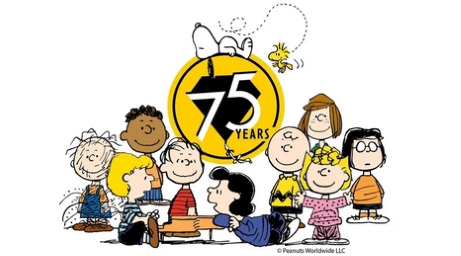
People like to celebrate time and numbers—the 75th anniversary of the world’s greatest comic strip, fifty years of one man’s genius, and his nearly 18,000 combined dailies and Sundays. That’s a lot of hours, paper, and ink. But most important, it’s a lot of love. That’s what we’re really celebrating.

For as long as I can remember, I’ve been in love with Charles M. “Sparky” Schulz and his comic strip masterpiece. He shaped my life and career in countless ways. Like so many kids in the sixties, I was captivated by his intimate characters and their precious world. Every night, I read my beloved well worn Peanuts paperbacks from Rinehart & Company before going to sleep. I dreamed of one day becoming a cartoonist and having a dog like Snoopy. Dreams can come true, and the best part of mine was meeting and becoming friends with my boyhood hero.
Sparky was everything you’d want the guy who drew Peanuts to be: kind like Linus, funny like Snoopy, determined like Lucy, dedicated to his art like Schroeder, and always there for you like good ol’ Charlie Brown.
At his core, Sparky was a cartoonist, part of a unique profession with a proud, rich history—a profession he cherished his entire life. He enjoyed the camaraderie of his fellow pen-pushers, discussing his favorites like George Herriman’s Krazy Kat, E. C. Segar’s Popeye, Percy Crosby’s Skippy, and Roy Crane’s Wash Tubbs and Captain Easy. Sparky delighted in talking shop, the beauty of a pen line, and the rigors of the daily deadline. And like all syndicated cartoonists, Sparky spent most of his time at his drawing board, doing what made him happiest.
As the years went by, I could almost say that drawing a comic strip for me became like a religion. Because it helps me survive from day to day. I always have this to fall back on. When everything seems hopeless and all of that, I know I can come to the studio and think, ‘Here’s where I’m at home. This is where I belong—in this room drawing pictures.’
Sparky graciously shared his wonderful gift with the world, and we embraced it wholeheartedly. Peanuts became ours—part of our fabric, our language, our history. Twenty-five years ago, Sparky asked me to choose the strips for the Peanuts: A Golden Celebration book. A moment in my life that today seems even more surreal. The Greatest of All Time trusted me to select my favorites from almost fifty years of his work. This was before the digital age, so his syndicate, United Feature, mailed me giant boxes filled with printouts—nearly 2,600 weeks of Peanuts strips. Diving in, I was mentally, emotionally, and physically immersed in the work. It was heaven.
I think cartooning has a certain quality and a certain charm unlike any other medium . . . a bringing of joy,
a bringing of happiness.
Sparky once told me that a cartoonist is like a baseball hitter. If your batting average is .300, you are an “All-Star.” Sparky’s batting average was phenomenal, which made it very difficult to decide which strips would make the cut. He only edited out a handful of my picks, including those from the week where Charlie Brown tries to be a cartoonist. I didn’t ask why. He also said if it was up to him, none of his early work from the 1950s would be included, since he felt he hadn’t reached his stride yet. A perfectionist, Sparky was his own toughest critic.
Comic strips aren’t art; they never will be. They are too transient. Art is something which is so good it speaks to succeeding generations, not only as it speaks to the first generation but better.
I beg to differ, but Peanuts is art. Seventy-five years after its debut, the strip still resonates. Even in a digital world, with newspapers fading, Peanuts lives on. It speaks to our humanity in a timeless, honest, funny, and accessible way. No matter how much tech overtakes us, Sparky’s oeuvre still touches who we really are.
For a shy, quiet kid from Minnesota, Sparky was quite a revolutionary. When Peanuts first appeared, it was unlike anything else on the funny pages. Peanuts gave the medium a different timing, a new rhythm. His minimalist art and conversational dialogue changed the way comic strips were drawn and written. They became more personal and exploratory of our inner world.
I think I’m speaking to people about things that really affect them. I think I’m doing what poetry does in a
grander manner, but I’m doing it for the layman. I’m identifying things that the average person only feels
vaguely. I’m defining emotions.
Like poetry, creating a small four-panel daily comic strip is about paring it all down to the heartfelt essential. There’s a Zen quality to it, finding just the right words to express your thoughts, and drawing just a few perfect blades of grass to establish place. It’s theater of the mind.
How can a playwright go wrong when the audience is doing part of his work for him?

As both playwright and director, the cartoonist aims to get the most out of their actors. Expressions and actions help deliver the dialogue. A great comic strip is the perfect marriage of words and pictures. No cartoonist was better at this than Charles M. Schulz. Take any strip from this collection and spend the time to read his words and study the “acting” of the characters. His cast performs his stories sublimely. The pacing and timing are immaculate. Their body language is exquisite—expressive hands, the slight tilt of a head, the wide open mouths. When walking, feet barely touch the ground, as if walking on air. And the cast’s expressions—no artist captured pure joy or devastating sadness better, as seen in Charlie Brown’s squiggly smile or the frown that covers his entire face and the brackets around his heartbreaking eyes.
Sparky’s exaggerated comic inventiveness brought us moments like Linus literally floating with love for Miss Othmar; Snoopy’s happy dance; and Charlie Brown on the mound, losing his shoes, socks, shirt, and hat after a line drive, or falling with a big WUMP! after Lucy pulls the football away.
Cartooning is, after all, drawing funny pictures. Something a cartoonist should never forget.
Sparky conveyed not only the big emotions but the subtle ones, too—Snoopy’s sly wink, Lucy’s boredom, Sally’s side-eye, Linus’s contentment, or Charlie Brown’s little tongue popping out as he struggles to write with a fountain pen. You know what they’re thinking behind those black dots for eyes. Sparky felt that pain and joy deep inside him, and somehow transferred that symbiotic energy so it flowed out of his pen and manifested in India ink. A few perfectly placed abstract dots and squiggles conveyed honest emotions, making the characters and their stories come alive on the page. So much so that they became our friends and family. This is what happens when you put your heart and soul into your art. That’s the magic of Charles M. Schulz.
Sparky called this drawing style “warmth.”
Now I think warmth is very, very important. Cartoon characters should have warmth.
With his being from Minnesota, I’m guessing warmth might have been another word for love. And that’s what we’re celebrating here with this wonderful collection of Sparky’s funny pictures.
Happy 75th anniversary!

Patrick McDonnell is the bestselling author, illustrator, playwright, painter, and creator of the comic strip Mutts, which appears in more than 700 news papers around the world. He has received numerous awards, including a Caldecott Honor and the Reuben Award, the highest recognition given by the National Cartoonists Society. He is the author of The Art of Nothing (Abrams ComicArts, 2019), The Super Hero’s Journey (Marvel Arts, 2023), and Breaking the Chain (Abrams ComicArts, 2024). He lives in New Jersey.
Introduction (and Earl) © Patrick McDonnell; Peanuts characters © Peanuts Worldwide

Comments 5
Comments are closed.